How to make a Game Boy Color RPG with AI
To make a Game Boy Color RPG with AI, open Shiny Gen, start a new game on the GBC Engine, and describe the RPG in the Agent tab: the hero, the town, the quest, the battles and the look. The AI agent writes the game, draws the pixel art as code, compiles a real Game Boy Color cartridge, plays it and fixes what it finds. We did that for this guide. Five messages gave Lighthouse Knight: a knight in a seaside town, a mayor whose quest you can accept or refuse, an inn that heals for 10 gold, a potion shop, turn-based battles against slimes in tall grass with gold, experience and level-ups, and a slime king. It took about fifteen minutes of agent time and 195 gems.
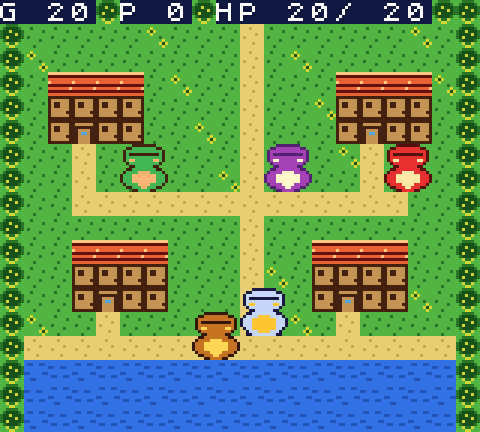
The test: five messages, one RPG
Everything below is from one real session on 24 November 2026, recorded in the Shiny Gen app. The prompts are copied word for word, the AI's messages are quoted from the chat, and the pictures are screenshots of the app or frames drawn by the cartridge. Nothing was edited by hand.
| Message | What we sent | Agent time | Gems |
|---|---|---|---|
| 1 | The RPG, with the art asked for up front | 5 min 31 s | 10 |
| 2 | "continue" | 1 min 37 s | 32 |
| 3 | "continue" | 1 min 15 s | 17 |
| 4 | An inn, gold from slimes and a shop | 1 min 55 s | 40 |
| 5 | "continue" | 4 min 21 s | 96 |
An RPG is a bigger job than an arcade game, so the agent builds it a piece at a time. Each turn ends by saying what works, what it tested and what is still to build, and "continue" picks it up again.
Step by step: the RPG we made
1. Start a Game Boy Color game
Press +, choose New, then pick GBC Engine on the Choose an engine screen. In a browser, this link opens a new GBC game directly. The Agent tab is where you talk to the AI.
2. Describe the RPG, art included
Our first prompt, exactly:
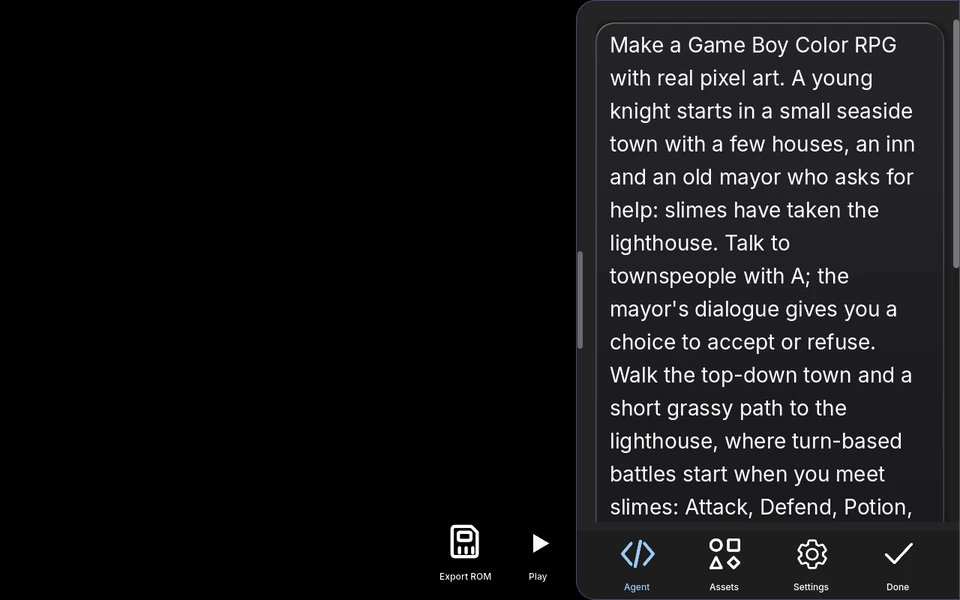
It names the parts an RPG needs: a place, people to talk to, a reason to leave, a fight system with numbers, a goal and the screens around it. "Draw all the art yourself as code" tells the agent to draw every tile and sprite as a small script it can redraw on request.
3. Let it plan, then send "continue"
The agent spent the first turn reading the Game Boy Color reference and planning. It settled on one screen per area rather than a scrolling map:
In our recording that first turn then stopped with a connection error before it had written any code, so we sent "continue". The second turn built the first playable slice: a title screen, the town drawn from code-made tiles (grass, flowers, sand, water, houses and trees) and a 16 x 16 knight walking in four directions. It was plain about how much was left:
4. Talk to the mayor
The third turn, another "continue", added the mayor, a villager and the text box. It played its own game and found a bug of its own on the way: the knight had started inside the water and could not move.
The mayor's request comes up in a text box, Left and Right pick YES or NO, and A confirms. Accept and he sends you north; talk to him again and he wishes you luck.
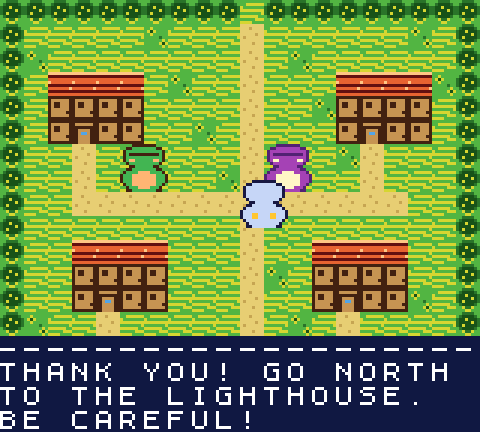
The agent listed what it had not checked: the NO answer, the villager, and a streaky look on the grass in some of its screenshots that it could not tell apart from a capture glitch. It also noted that the townspeople reused the knight's tiles in other colors, which is why they look alike.
5. Ask for the next change, and read the answer
Our fourth message asked for things that leaned on battles:
The agent built the inn, the shop and a gold, potion and HP bar along the top, fixed a freeze at startup it had caused, and said what it could not do yet:
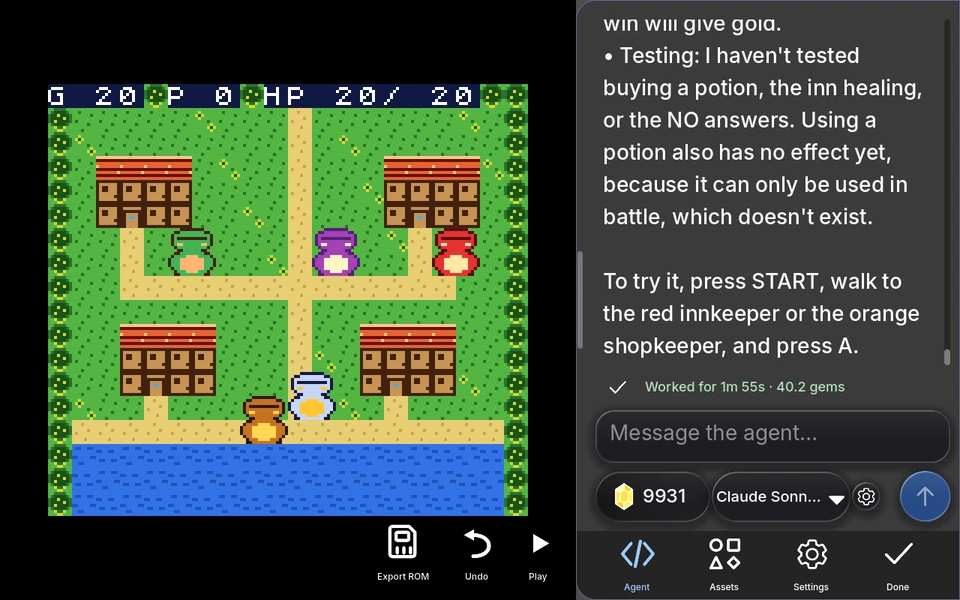
This is worth learning from: we asked for slime gold before there were slimes. The agent did not pretend; it built what could be built and said what was missing. Asking for one layer at a time gets there faster.
6. The battles and the slime king
The fifth message, "continue", built the battle system. Walking into the tall grass on the path starts a fight with a menu of Attack, Defend, Potion and Run, HP for both sides, and a text line for each move.
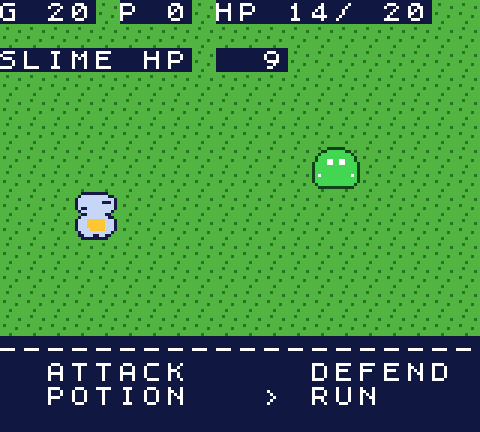
The agent played the first battle itself:
It won it (VICTORY, GOLD + 11, XP + 6), so the slimes now drop the gold the fourth message asked for. To reach the boss quickly, it then moved the knight straight to the lighthouse door with the quest accepted and fought the slime king, which gave GOLD + 50 and XP + 40 and a level-up, then went on to the ending screen.
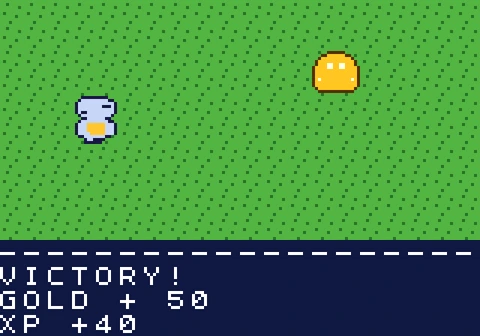
It then tested Defend and Potion with none left ("NO POTIONS LEFT"), and the turn stopped at the per-message gem limit while it was testing Run. In our own short play afterwards, Run answered "CANNOT ESCAPE!" each time we chose it, so Run is the first thing we would ask the agent to look at next.
7. Play it and download the ROM
The game plays in the editor and from its card: on-screen buttons on a phone, the keyboard or a controller on a computer. Press Share, then Export .gbc ROM to download the cartridge. Exporting costs $25 per game, or comes with a plan, and you can re-export that game any time. The ROM guide covers emulators and flash carts.
What we learned from the test
- Build an RPG in layers. Town and walking first, then talking, then battles, then the shop and the boss. Asking for gold drops before battles existed cost a message.
- Read the "not tested" list. Every turn ended with one. Here that was the NO answer, the villager, Run, and the lighthouse floors, which the agent skipped over to reach the boss.
- Expect "continue" and the per-message limit. Bigger turns stop at the limit you set for one message; sending a message carries on, or you can raise the limit.
- Play it yourself. The agent tests by pressing buttons and reading the game's memory. Balance, how long a fight takes and whether the town feels alive are for you to judge.
What to put in an RPG prompt
- The hero and the start: who they are and where they begin.
- The world: the areas, and whether each is one screen or a scrolling map.
- People and dialogue: who says what, and any choices.
- The fight system: the menu, HP, damage, experience and levels, and what starts a fight.
- Money and items: gold, a shop, an inn, potions.
- The goal: a boss, an ending screen.
- The look: tile sizes, colors, and "draw the art yourself as code".
What the Game Boy Color can hold, for an RPG
- Screen: 160 x 144 pixels, which is 20 x 18 tiles. That is why the agent made one screen per area.
- Text: about 20 characters a line, so dialogue comes in short lines in a text box.
- Colors: eight background palettes and eight sprite palettes of four colors each (on sprites one is transparent).
- Sprites: 40 on screen, at most ten on one line. A 16 x 16 hero is four of them, so a crowded town fills up fast.
- Memory: about 4.5 KB for your game's variables, with 16-bit whole numbers. Plenty for HP, gold and a party, not for huge item lists.
- Saves: a battery-backed save in the cartridge, so an RPG can remember your progress.
Every build reports how full each budget is.
Ideas to ask for next
- "Make Run work half the time, and never against the slime king."
- "Draw the lighthouse floors as their own screens, with stairs between them."
- "Give the townspeople their own sprites."
- "Add a save point at the inn."
- "Add a second hero who joins after the first battle."
For a monster-catching RPG instead, see our GBA monster RPG test.
FAQ
Can AI make a Game Boy Color RPG?
Yes. Pick the GBC engine in Shiny Gen and describe the RPG; the agent writes it, draws it, compiles a real Game Boy Color cartridge, plays it and fixes bugs. This one took five messages, about fifteen minutes of agent time and 195 gems.
Can AI make an RPG like Pokemon or Dragon Quest?
Yes, a game in the same genre: a town, a quest, turn-based battles, experience and a boss, like the one on this page, or monster catching like our GBA test. Make it your own: your own hero, monsters, names and art, especially if you share or sell your game.
Is it a real .gbc ROM?
Yes. It is a Game Boy Color cartridge image compiled to the machine's own code. We have played Game Boy Color ROMs made this way on a Game Boy Advance and a ModRetro Chromatic through a flash cart, and any GBC emulator opens it.
Why did the agent stop in the middle?
Each message has a limit on the gems it can spend, which you can change, and each turn has a budget of steps. A whole RPG is more than one turn, so the agent says what is left and "continue" carries on.
Do I need to know how to code?
No. You describe the game and the agent writes and tests the code. You can read and edit it in the Code view, and editing it by hand costs nothing.
Is it free?
Making, playing and sharing games is free. The built-in agent uses gems, and new accounts get free gems. Downloading the ROM costs $25 per game, or comes with a plan. See the pricing page.