How to make a monster-catching RPG for the Game Boy Advance with AI
Also in: Español · Deutsch · Français · Português · Italiano · Nederlands · Svenska · Norsk · Bahasa Indonesia · Türkçe · Polski · Tiếng Việt · Русский · 日本語 · 한국어 · 繁體中文
To make a monster-catching RPG for the Game Boy Advance with AI, open Shiny Gen, start a new game on the GBA Engine, and describe the game in the Agent tab: the starter pick, where wild creatures appear, how battles and catching work, and the controls. The AI agent writes the game, compiles a real GBA cartridge, plays it and fixes what it finds. We did exactly that for this guide: three prompts gave a playable game with a village, tall grass, turn-based battles, catching, pixel art, a rival and levels, in about eight minutes of agent time and 31 gems. It was also still rough in places, and this page shows both.
The test: three prompts, one game
Everything below comes from one real session on 23 November 2026, recorded in the Shiny Gen app. The prompts are copied word for word, the AI's messages are quoted from the chat, and every picture is a screenshot of the app or a frame drawn by the cartridge. Nothing was edited by hand.
| Prompt | What it asked for | Agent time | Gems |
|---|---|---|---|
| 1 | The game: village, starter pick, tall grass, turn-based battles, capsules, a team of three, a healer, controls | 3 min 59 s | 10 |
| 2 | Pixel art instead of text characters | 2 min 9 s | 8 |
| 3 | A rival, XP and levels, a victory screen | 1 min 37 s | 13 |
New accounts get free gems, and the smallest gem pack ($2.99 for 150 gems) would cover it about five times over. Gems pay for the AI; downloading the finished ROM is separate: $25 per game, or included in a plan.
Step by step: the game we made
1. Start a GBA game
Press +, choose New, then pick GBA Engine on the Choose an engine screen. A blank cartridge opens in the editor, and the Agent tab is where you talk to the AI. In a browser, this link opens a new GBA game directly.
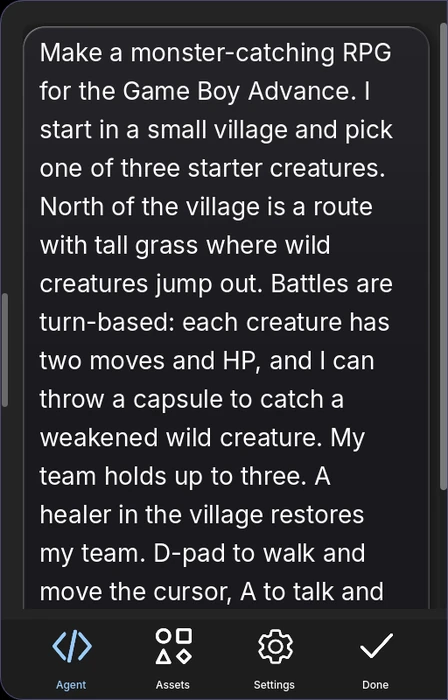
2. Type the first prompt
This is the first prompt we sent, exactly:
3. Watch it build, play and fix
The agent read the GBA language reference, wrote a first playable version, built it and started playing it. Its first messages:
init() never turns video on, so I'll fix that first.Then it walked the map with the D-pad, read the game's own variables to see where the player really was, and fixed what it found, such as a wall the player could not pass:
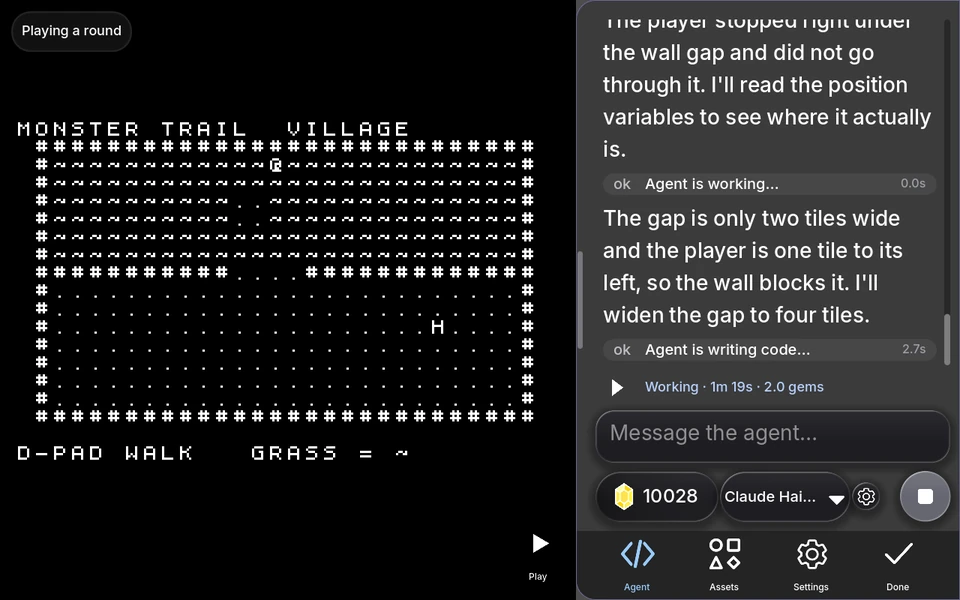
In the first turn it made 37 tool calls (writing code, building, pressing buttons, taking screenshots, reading values) in four minutes, and none failed. The result worked: a starter pick of Emberling, Mosspup and Puddlefin, a village with a healer, a route of tall grass, random encounters and turn-based battles with capsules. But it drew everything with text characters, because we had not asked for art. Its last message said so plainly:
4. Ask for the art
The second prompt:
"Draw the art yourself as code" tells the agent to write each picture as a small image script, which it can redraw on request, rather than generating it with an image model. It drew a player sprite, six creature sprites at 32 x 32 and a background tileset, and explained a real GBA limit on the way:
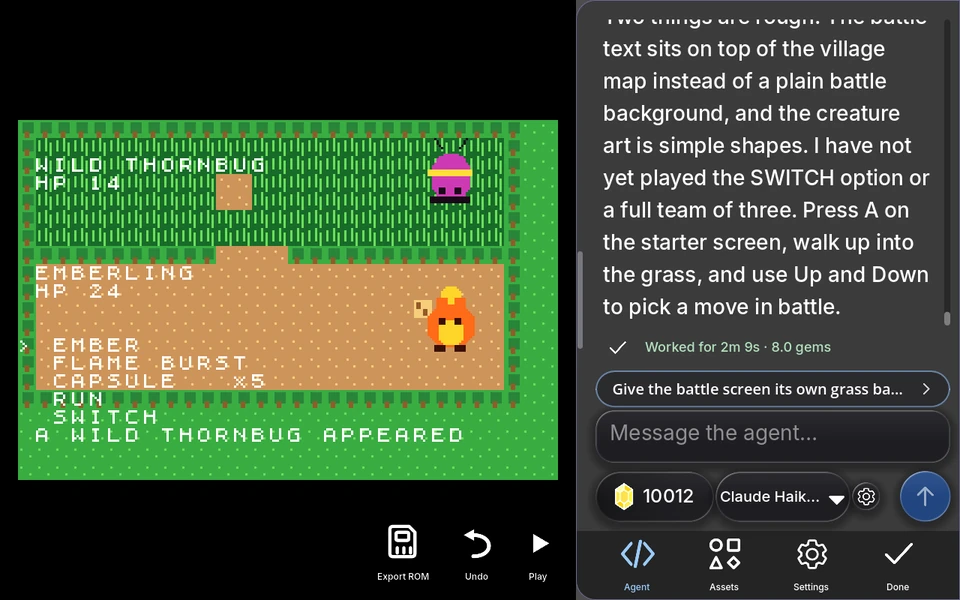
It finished in two minutes and was honest about the rough parts:
5. Add the next system
The third prompt:
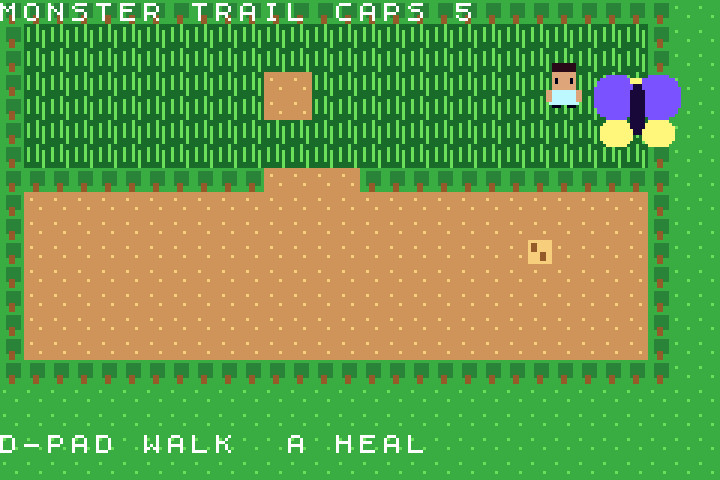
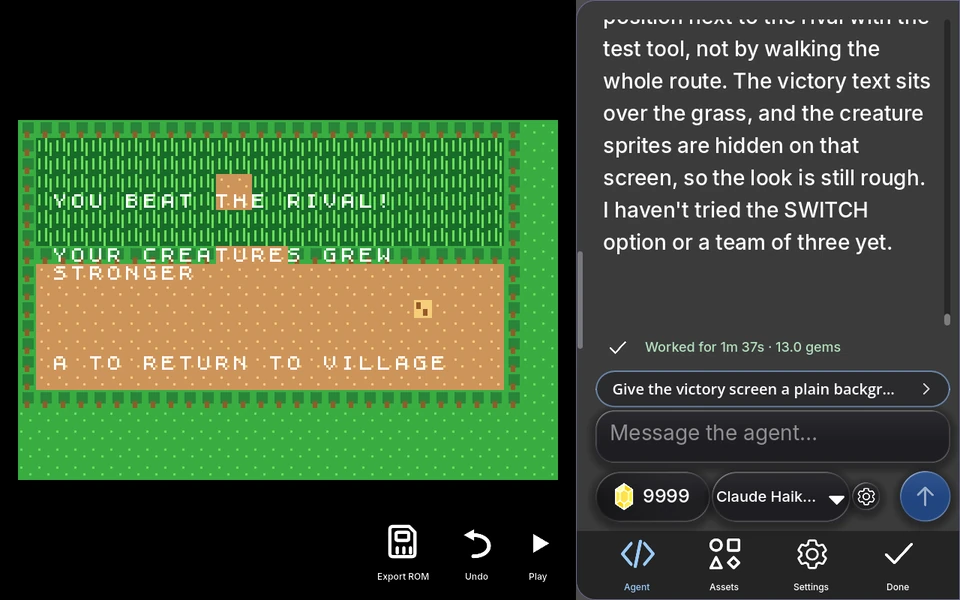
The agent added the rival, experience and levels in ten edits, then played the fight through, both rival creatures, until the victory screen showed. Its reply:
6. Play it, keep going, and download the ROM
The game plays in the editor and from its card: on-screen buttons on a phone, the keyboard or a controller on a computer. After each reply the chat offered a suggested next change as a button, such as "Give the victory screen a plain background".
When you are happy with it, press Share, then Export .gba ROM. Exporting costs $25 per game, or comes with a plan, and you can re-export that game any time. Shiny Gen boots the cartridge in a fresh emulator to check it starts, then hands you the .gba file for an emulator or a flash cart. The ROM guide covers both; downloading costs the same $25 per game, or comes with a plan.
What we learned from the test
- Ask for art in the first prompt if you want it. We left it out on purpose to show what happens: the first version used text characters until we asked.
- One system per prompt works. Each prompt added one layer (the game, the art, the rival), and each turn ended with a game that built and ran.
- Read the agent's last message. It said what it had not tested yet (the Switch option, a full team of three) and what still looked rough, so we knew what to ask for next.
- Three prompts make a playable start, not a finished game. A polished monster RPG takes more rounds: a battle background, better creature art, more routes, saving. Each is another sentence.
What to put in your first prompt
A monster-catching RPG, the genre the Pokemon games made famous, is many small systems at once: a map, encounters, a battle screen, a team, catching, healing, and usually experience and a rival. The agent builds what you name. A strong first message covers:
- The loop: where the player starts, where wild creatures appear, and how a battle starts.
- Battles: turn-based, how many moves each creature has, what HP does, and how you win or flee.
- Catching: what you throw, when it works (for example only on a weakened creature), and how big your team can be.
- Recovery: a healer or an inn, so a lost battle is not the end.
- Controls: the GBA has a D-pad, A, B, L, R, Start and Select. Say which does what.
- The look: pixel art, the size of the creatures in battle, the colors.
What the GBA can hold
Our GBA engine keeps to the real machine, and a monster RPG touches most of its budgets:
- Screen and sprites: 240 x 160 pixels; up to 128 sprites at once, each up to 64 x 64. That is why the agent drew the map as background tiles and kept sprites for the player and the creatures.
- Colors: palettes of 16 colors. Each creature with its own colors uses a palette, so a large roster of very different colors fills them; the build warns you.
- Memory: 256 KB of working memory for your game's data, plenty for a party, a roster table and a route. There is no floating point, so stats and damage use whole or fixed-point numbers.
- Saves: a 128 KB flash save, like a real cartridge, so the team and progress can survive turning the game off. Ask for it: "Save the game when I talk to the healer."
- Text: text boxes for dialogue and battle messages are built in.
Every build reports how full each budget is, tightest first.
Ideas to ask for next
- "Give the battle screen its own grass background, and draw the creatures bigger."
- "Add evolution: a creature changes form at level 5."
- "Give each creature a type, and make some types hit others harder."
- "Add a second route with different creatures and a cave."
- "Save the game when I talk to the healer."
- "Add a title screen with the three starters on it."
FAQ
Can AI make a monster-catching RPG?
Yes. In Shiny Gen you pick the GBA engine and describe the game; the agent builds the map, battles, catching and team, compiles a real Game Boy Advance cartridge, plays it and fixes bugs. The game on this page took three prompts, about eight minutes of agent time and 31 gems. Downloading the .gba ROM costs $25 per game, or comes with a plan.
Can AI make a game like Pokemon?
Yes, a game in the same genre: a monster-catching RPG with a starter pick, wild creatures in tall grass, turn-based battles, catching, a team and a rival, like the one on this page. Make the creatures your own: your own names, designs and art rather than Pokemon's, especially if you share or sell your game. The agent invented Emberling, Mosspup, Puddlefin and Thornbug for this one, and you can draw or upload your own art. Shiny Gen is not connected with the Pokemon games or their makers.
Is it a real GBA ROM?
Yes. It is a standard .gba cartridge image compiled to ARM machine code. We have played ROMs made this way, saves included, on a Game Boy Advance and a DS Lite through a flash cart, and any GBA emulator opens it.
How many prompts does a monster RPG take?
Three gave us a playable game with art, a rival and levels. A finished, polished game takes more: think of each prompt as one feature or one round of fixes.
Can my game trade monsters with other games?
Our own Shiny Monsters games on Game Boy Color, Game Boy Advance and DS trade and battle with each other over the internet inside Shiny Gen; try Shiny Monsters Advance. Trading over a real link cable on hardware is not proven, so we do not claim it.
Do I need to know how to code?
No. You describe the game and the agent writes and tests the code. You can read and edit it in the Code view if you want to, and editing it by hand costs nothing.
Is it free?
Making, playing and sharing games is free. The built-in agent and AI generation use gems, and new accounts get free gems. Downloading the ROM costs $25 per game, or comes with a plan. See the pricing page.